

Are you thinking of buying yourself a Tesla? One of the major reasons why most people consider buying a Tesla or any electric vehicle is due to the ever-rising cost of fuel. Electricity charging is much more affordable and clean compared to gas. However, before you make that big decision, how much will it cost you to charge a Tesla? And how long does it take to fully charge a Tesla’s battery?
In this article, let’s explore the charging costs of Tesla at home, how long it takes, and other factors surrounding charging your Tesla. Please keep on reading!
What Are the Charging Options for Tesla Cars?
There are several models for Tesla each with varying charging options. Generally, the charging rates range from slow to fast. Therefore, the answer to the question, “how much to charge a Tesla” varies depending on the charging level. Here are the different charging levels for Tesla.
1. Level 1
The 120-Volt or 240-Volt is a suitable Household Charging Cable for your Tesla. It is the slowest compared to other chargers. The charging rate is 4.8 km per hour. According to Tesla, you are supposed to get 48 to 64 km of charging per day. It can take approximately 20 hours to fully charge your EV. The level 1 charger is a great option for short drives or if you don’t drive your car daily.
2. Level 2 Home Charger
The level 2 or the 240-Volt Tesla charger has a higher amperage and it charges faster. It charges approximately 70 km per hour. Suitable for home and public charging. Since level 2 chargers have a high voltage, an electrician must install them in your home.
3. DC Fast Charger
DC fast chargers are quite common ranging from 50 kW to 350 kW. As the Kw increases, the charging time is shorter. If you are using a CHAdeMO adapter, you can charge up to 160.9 km range in only 30 minutes.
4. Supercharger
The supercharger is the fastest method of charging your Tesla. The supercharger delivers approximately 321.8 km range in 15 minutes.
What Are the Costs of Tesla Home Charging in Various Provinces?
Generally, the electric cost of charging a Tesla depends on the car model and the size of the battery. Also, the cost of electricity per kilowatt hour (kWh) in your province or location will influence the cost of charging your Tesla. Here’s a breakdown of the charging costs for various Tesla models.
Tesla Model 3
The Tesla Model 3 comes with two types of batteries, the 84-kWh for Dual Motor All-Wheel-Drive (AWD) and the 60-kWh for the base model. Typically, the larger capacity battery will have a higher charging cost compared to the lower capacity battery. Here are the approximate costs for charging the two batteries in various provinces.
Tesla Model 3
|
Provinces |
Cost $ 60-kWh Battery |
Cost $ 84-kWh Battery |
|
Alberta |
$ 8.10 |
$11.07 |
|
British Columbia |
$7.96 |
$10.88 |
|
Manitoba |
$5.59 |
$7.65 |
|
New Brunswick |
$6.83 |
$9.33 |
|
Newfoundland & Labrador |
$7.41 |
$10.12 |
|
Nova Scotia |
$5.57 to $12.34 |
$7.62 to $ 16.87 |
|
Northwest Territories |
$18.36 to $42.10 |
$ 25.09 to $57.53 |
|
Nunavut |
$18.60 to $ 37.20 |
$25.42 to $ 50.84 |
|
Ontario |
$4.44 to $ 9.06 |
$6.07 to $ 12.38 |
|
Prince Edward Island |
$7.13 to $8.95 |
$9.74 to $ 12.23 |
|
Quebec |
$4.38 |
$5.99 |
|
Saskatchewan |
$8.82 |
$12.06 |
|
Yukon Territory |
$7.28 to $8.39 |
$ 9.95 to $ 11.47 |
Tesla Model Y, Tesla Model S, and Tesla Model X
Tesla Model Y comes with only a battery variant, the 82-kWh similar to the Model 3. So, the charging costs are similar to that of model 3.
The latest Tesla Model S comes in two trims, the Base model and the Plaid trim. Both trims have a 100-kWh lithium-ion battery which. The Tesla Model X SUV runs on a 100-kWh battery, similar to the Model S.
The cost of charging Tesla models Y, S, and X in each province is as follows:
Tesla Model Y, Model S, and Model X
|
Provinces |
Tesla Y Costs ($) |
Tesla S Costs ($) |
Tesla X Costs ($) |
|
Northwest Territories |
$ 25 to $57.53 |
$30.60 to $70.16 |
$30.60 to $70.16 |
|
Nunavut |
$25.42 to $50.84 |
$31.00 to $62.00 |
$31.00 to $62.00 |
|
Saskatchewan |
$12.06 |
$14.71 |
$14.71 |
|
Alberta |
$11.07 |
$13.50 |
$13.50 |
|
British Columbia |
$10.88 |
$13.27 |
$13.27 |
|
Newfoundland & Labrador |
$10.12 |
$12.35 |
$12.35 |
|
Yukon Territory |
$9.95 to $ 12.23 |
$12.14 to $13.99 |
$12.14 to $13.99 |
|
Prince Edward Island |
$9.74 to $12.23 |
$11.88 to $14.92 |
$11.88 to $14.92 |
|
New Brunswick |
$9.33 |
$11.38 |
$11.38 |
|
Manitoba |
$7.65 |
$11.38 |
$9.32 |
|
Nova Scotia |
$7.62 to $ 16.87 |
$9.29 to $20.57 |
$9.29 to $20.57 |
|
Ontario |
|
$7.40 to $15,10 |
$7.40 to $15,10 |
|
Quebec |
$5.99 |
$7.30 |
$7.30 |
Factors Influencing the Costs of Charging a Tesla
1. The Source of Electricity
The cost of electricity in Canada varies depending on the provider and location. If the cost of electricity is high in your area, the cost of charging your Tesla will be relatively higher compared to locations where the costs of electricity are much lower.
One of the most effective ways of reducing or eliminating the electricity cost of charging Tesla is by using solar power. You can pay a much lower price by charging your Tesla at a community solar. However, it could be cheaper if you install a solar system in your home. That means you will charge your Tesla for free and also eliminate the electricity costs in your home.
2. Size of the Car Battery
Various Tesla models have varying battery sizes. The size of the battery impacts the costs of charging it. If your Tesla has a large-capacity battery, the charge duration and costs will be higher.
3. Type of Charger
The charger type affects the speed rate and cost of charging a Tesla. The fastest charging Tesla charger is the Tesla Supercharger with a high charge rate per kilowatt/hour. Other commonly used chargers are level 2 and home chargers.
4. Your Location
Where you live can determine the cost of charging your Tesla. There are areas that have higher electricity costs compared to others.
5. Charging Time
Another factor that affects the costs of charging your Tesla is a time of the day or week. Electricity providers have off-peak hours where they offer lower electricity rates. So, you can schedule charging your Tesla during off-peak to enjoy low costs.
How to Save Cost on Tesla Charging?
If you are considering installing a solar system at your home to save the charging costs, consider the following BLUETTI solar products.
1. BLUETTI Solar Panels
All the BLUETTI solar panels are portable to allow you to harness the sun's energy anywhere. They are available in various capacities ranging from 120W to 420W. All the solar panels have in-built monocrystalline silicon cells with a high conversion rate of 23.4%. Here are some of the BLUETTI solar panels:
BLUETTI SORA 500 Solar Panels
Specifications
-
Powerful solar charging. Deliver up to 500W of solar power to recharge your BLUETTI power station using sunlight.
-
Capture more sunlight. High-efficiency solar cells help convert sunlight into usable energy.
-
Easy to transport. The foldable design makes setup, storage, and transport more convenient for outdoor adventures.
-
Built for the outdoors. Designed for outdoor use, with weather resistance that helps protect against everyday conditions.
BLUETTI PV350 Solar Panels
Specifications
- 350W solar power
- Size: 35.6" x 24.1" / 90.5 x 61.3cm (folded) and 35.6" x 94.41" / 90.5 x 240cm (unfolded)
- Weight: 30.6lbs / 13.9kg
- Higher conversion rate at 23.4%
- Kickstand included for easy set-up
- Durable and splash-proof
- Foldable and portable
BLUETTI PV200 Solar Panels
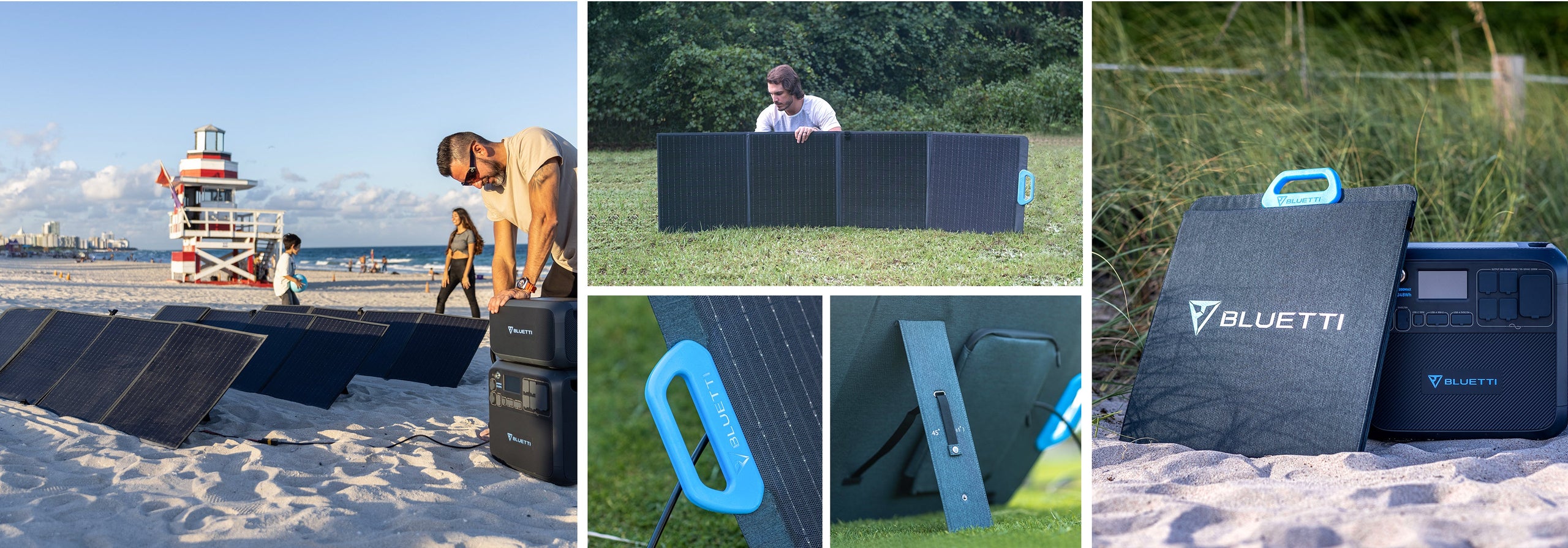
Specifications
- 200W solar power
- Dimensions: 23.2" x 24.8" / 59 x 60cm (folded) and 23.2" x 89.2" / 59 x 226.5cm (folded)
- Weight: 16.1lbs / 7.3kg
- Monocrystalline solar cells
- Up to 23.4% efficiency
- Highly durable and scratch-free ETFE coating
- Foldable for easy portability
- Compatible with other solar generators with MC4 connectors
2. Solar Generator
The BLUETTI solar generators are efficient, quiet, and eco-friendly power solutions for off-grid living. They store the energy tapped by the solar panels in their system through their batteries.
Solar generators are portable, easy to set up and safe to use in the house or in the RV. Here are some of the solar generator kits you should consider for convenient charging of your Tesla.
BLUETTI Apex 300 Home Backup Power Station
Features
-
Expandable Power Capacity – The BLUETTI Apex 300 starts with 2,764.8Wh of built-in battery capacity and can expand to up to 58kWh with a compatible multi-unit configuration, providing extended backup power for essential home appliances and devices.
-
High Power Output – Delivering 3,840W of continuous output as a standalone unit, the Apex 300 can reach up to 11,520W of continuous output in a compatible multi-unit setup, supporting more demanding household power needs.
-
Flexible Home Backup – With dual-voltage support and compatible expansion options, the Apex 300 can help power essential appliances during outages and reduce reliance on the grid.
-
Power for Tesla Charging – With sufficient system capacity and a compatible charging setup, the Apex 300 system may support Tesla charging. Actual charging compatibility and speed depend on the Tesla model, charger requirements, system configuration, and available power. Always verify the required voltage and charging equipment before connecting.
-
Solar and AC Charging – Recharge using compatible solar panels or AC power, giving you flexible ways to replenish energy at home or off-grid.
Final Thoughts
Are you considering buying a Tesla? We have broken down the costs of charging Tesla in various provinces. Home charging is convenient and cost-effective. You set up an EV charging station in your garage and leave your car to charge overnight to take advantage of off-peak hours.
However, with the rising costs of electricity, you can opt for a cheaper, effective, and eco-friendly mode of charging by using solar energy. However, you need to install a solar system in your home to make this possible. If you are considering installing a solar system in your home, check out the BLUETTI wide range of solar products.